


Why Finnish and Nordic Businesses Should Be Looking at East Africa Now

Few emerging regions are as natural a fit for Nordic companies as East Africa. The
alignment begins with the clock: the time difference between Finland and key East African markets never exceeds one hour, enabling seamless, real-time collaboration between teams in Helsinki, Kampala, Nairobi, and Kigali.
Beyond logistics, the region boasts a young, rapidly growing population of ambitious professionals who work fluently in English, with labor costs that remain highly competitive compared to Europe. For professionals weary of long Nordic winters, East Africa offers mild climates alongside world-class tourism opportunities from safari parks and mountain gorillas to Lake Victoria and the Indian Ocean coast making business trips easy to combine with leisure.
Interest in bilateral cooperation is remarkably strong. Across the region, business owners, investors, and institutions actively seek joint ventures, technology and knowledge transfer, institutional affiliations, and project financing. This interest flows both ways as wealthy East African investors are eyeing opportunities in Finland, while regional producers want Nordic market access, creating a genuine partnership where both sides bring huge value.
Attractive Incentives and Strong Economic Fundamentals
Governments across the region are fiercely competing for foreign investment through compelling fiscal and administrative incentives:
– Uganda: Offers corporate income tax holidays of up to 10 years for qualifying investors, alongside strict protection against expropriation under the Investment Code Act.
– Rwanda: Provides a preferential 0% corporate tax rate for international companies establishing a regional headquarters, 15% for other qualifying investors, and up to a 7-year tax holiday for major investments ($50M+) in targeted sectors.
– Kenya & Tanzania: Both feature specialized economic zones, with Kenya offering distinct administrative and fiscal incentives, and Tanzania’s investment authority providing export-oriented firms with 10-year tax holidays and duty-free import allowances for machinery and raw materials. (Investors should verify current guidelines with respective authorities prior to commitment.)
The macroeconomic data strongly support this momentum. The African Development Bank (AfDB) projects East Africa to remain the continent’s fastest-growing region, with growth figures of 7.0% in Rwanda, 6.2% in Uganda (projected to hit 8.0% in 2027 with the launch of oil production), 4.6% in Kenya, and 6.2% in Tanzania. Home to an estimated 300 million-plus people within the East African Community (EAC), total regional trade reached $156.6 billion, with intra-community trade growing by 28.2%.
With regional leaders targeting 50% intra-EAC trade by 2030, a foothold in one nation provides a strategic gateway to a massive, integrated market.
Mega-Projects and Regional Economic Spin-Offs
Major regional infrastructure undertakings are fundamentally reshaping East Africa’s macroeconomic landscape and unlocking extensive commercial opportunities. The development of the East African Crude Oil Pipeline (EACOP) stretching from Uganda to
Tanzania’s port of Tanga, alongside the Dangote Group’s multi-product refinery and integrated power plant project in Kenya, are serving as powerful catalysts for regional industrialization and cross-border trade. Beyond massive capital expenditures and
thousands of direct construction jobs, these mega-projects generate lucrative commercial spin-offs across multiple sectors. They drive heavy demand for local supply chains spanning logistics, specialized engineering, housing development, and heavy transport
while offering Nordic enterprises unprecedented avenues to deliver advanced green technology, environmental management systems, and technical training solutions. For Finnish and Nordic companies, positioning themselves early in these supply networks offers a direct route to participate in East Africa’s unfolding industrial era.
Strategic Alignment with Finland’s Africa Policy
Finland’s official Africa Strategy aiming to double bilateral trade and investment between 2020 and 2030 marks a crucial pivot toward deeper economic partnership rather than traditional development cooperation. The Ministry for Foreign Affairs and Business Finland highlight Kenya as a primary entry point, focusing heavily on responsible business, green technology, innovation, and knowledge transfer which are some of the core competencies of Finnish enterprise.
This perfectly mirrors East Africa’s long-term national development agendas:
– Uganda’s Vision 2040 targets competitive upper-middle-income status.
– Rwanda’s Vision 2050 aims for high-income status with a strong focus on
universal healthcare and education.
– Tanzania’s Vision 2050 centers on private-sector-led transformation.
– Kenya’s Vision 2030 drives industrialization and middle-income economic growth.
For Finnish companies specializing in clean energy, health, digital solutions, manufacturing, and education, these national visions create a natural pathway for expansion.
Navigating Market Entry with Confidence
Entering emerging markets is rarely without friction. Non-tariff barriers and policy changes can occasionally disrupt predictability, meaning incentives require careful navigation on the ground. Success in East Africa relies heavily on a business culture where trust and long-term personal relationships precede formal contracts, thorough partner verification, and having an experienced local bridge-builder to open doors early. As a Global Health & Cross-border Facilitator, I assist Finnish and Nordic investors in translating regional interest into operational, low-risk partnerships by leveraging an established network across public and private ecosystems in both regions.
About the Author
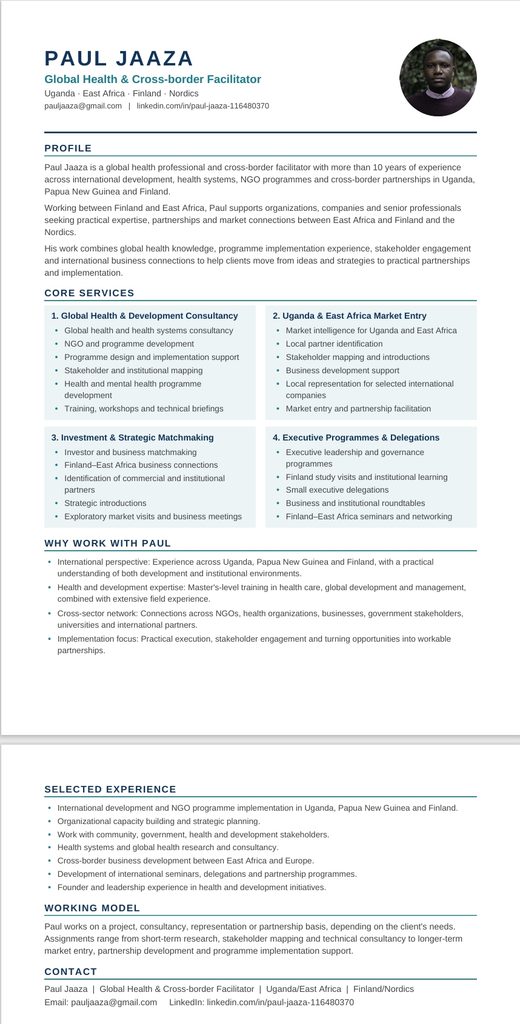
Paul Jaaza is a Global Health & Cross-border Facilitator with over a decade of experience
across Uganda, Papua New Guinea, and Finland. He specializes in supporting
organizations, enterprises, and senior professionals seeking strategic market entry and
cross-border partnerships between East Africa and the Nordics.
Contact: pauljaaza@gmail.com | LinkedIn Profile
References & Official Sources
AfDB: East Africa Economic Outlook 2026 (including Rwanda, Uganda, and Kenya
country outlooks).
World Bank: Global Economic Prospects (Sub-Saharan Africa Highlights).
East African Business Council (EABC): East Africa Trade and Investment
Climate Report 2026 & Tanzania CEOs Roundtable.
Government of Finland: Finland’s Africa Strategy (Ministry for Foreign Affairs /
Valtioneuvosto).
Investment Authorities: Uganda Investment Authority, Rwanda Development
Board, Kenya High Commission (UK), and Tanzania Investment Authority.
National Development Visions: Uganda Vision 2040, Rwanda Vision 2050,
Tanzania Vision 2050, and Kenya Vision 2030.
CV
 Takaisin uutiset-sivulle